 |
|---|

The second thing you notice are the materials. We use only amorphous, anti-resonant, high-stiffness, acoustically inert materials in our enclosures. Thus, vibration, noise, and distortion are all dramatically reduced or even eliminated.
Finally, the design and construction of the speaker enclosures uses a unique approach. Our approach combines proven principles (Refs 5,6,7) with cutting-edge scientific knowledge obtained from our own experiments. We use a proprietary "wave-mapping" procedure to model a design on a computer. Bass-port enclosures are designed using several software packages, to double and triple-check acoustic action. The enclosures are constructed as a series of one-piece spherical layers, so there are no joints in the structure. We also try to take into account the actual environment in which the speakers will be placed.(Ref. 3) For example, we made a pair of speakers for an apartment situation where the left side has not only the door (which may be open or closed) but a pathway into the kitchen to fill as well. Our solution was to seal the right speaker (which is in a smooth corner) into a stone-textured(black granite) sphere, then we gave the left speaker a crystal-clear ball with dual 1-inch diameter port tubes, angled to fill both the door, the kitchen, and match up with the other speaker facing into the living room. The result was a pair of speakers that really make a statement, both sonically and visually.
How much extra does it cost the manufacturer? Costs are equal or lower than the manufacture of current enclosure designs. The design is well-suited for mass manufacturing.
Why does it work? The enclosure is designed using fundamental and applied principles of physics and engineering (Refs 1,4). Our wave-mapping procedure and bass-port design algorithm was inspired by and draws upon wave mechanics physics(Refs 8,9). The enclosure materials are amorphous, thus they are anti-resonant all the way down to the molecular level. High-stiffness materials reduce vibration. Laminating composite materials makes the enclosure both airtight and strong.
Both the interior and exterior shape, materials, and construction assist the driver or drivers to deliver the ultimate sound it is capable of. To quote Tappan (Ref 12) "A wall that is curved in one or both dimensions is more rigid perpendicular to its surface than a flat wall...The improvement of a wall with reasonable curvature over a flat one is so great that a curved panel of thin cardboard is frequently acoustically adequate".
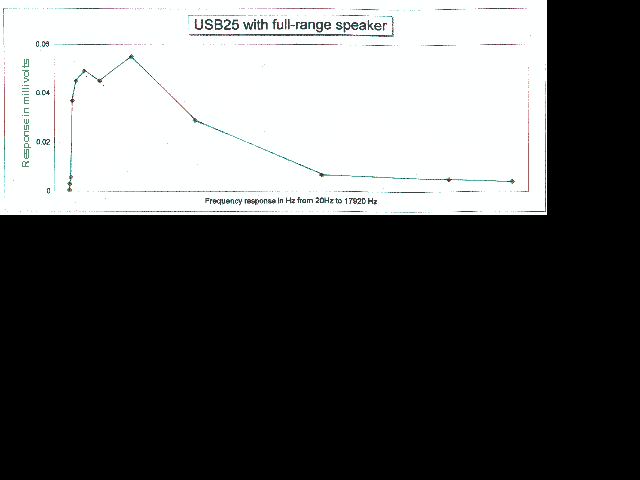
What are the test results? We took a $17 Radio Shack speaker and put it into enclosures with identical interior volume. Both tests were run in the same room, in the same location, in the same position. Both speakers were sealed into the enclosure. Both enclosures are lined with long-staple fiberfill for back-wave damping. The only difference between the enclosures is shape, materials, and construction.
The tests were conducted using a Super Omni microphone and a series of computer-generated test tones at 20, 40, 80, 160, 320, 640, 1280, 2560, 5120, 10240, 15360, and 17920 Hz. The microphone and test tones were run through separate amplifiers to avoid crosstalk or feedback. The microphone was suspended from the speaker face center axis at a distance of approximately 18 inches. Response from each tone was measured three times for accuracy and the most stable or average value was recorded.
Here we have the test results for our USB25 enclosure using a full-range speaker:
Here are the test results for the same speaker in the rectangular enclosure. The rectangular enclosure was constructed of industry-standard MDF particle board glued and screwed together, then sealed and lined with sound-absorbing insulation.
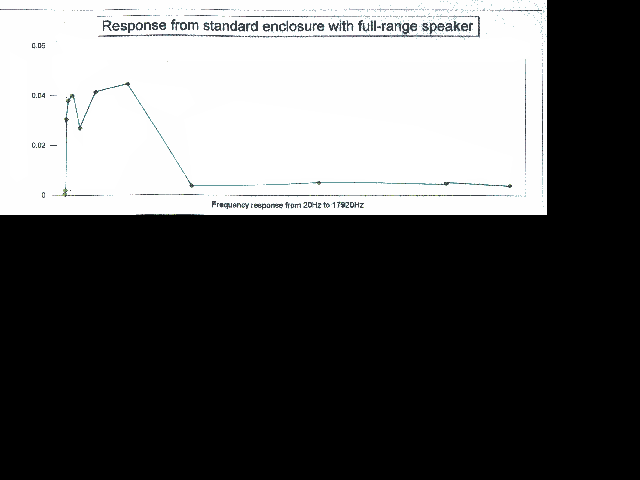
In conclusion, we believe that the U.S. enclosures offer superior value and performance compared to standard enclosures. We could show many graphs, experimental data, research documentation, and equations, but ultimately, you have to hear it to believe it. Every person who has listened to our speakers has compared them to speakers costing several times more. The response graphs cannot show you how the speakers seem to redefine the space of a room. Nor can they convey the clarity with which sounds appear to hang in the air. And this is only what we have accomplished with about $80 worth of parts purchased retail.
1. ELEMENTS OF AUDIO ENGINEERING
Harry F. Olson, EE, Ph.D, Acoustical Research Dir., RCA labs, Princeton ©1947, D. Van Nostrand Co., Inc., NY
2. "The Home Experimenter's Guide to Multi Channel Listening"
Ralph Hodges, Stereo Review, October 1971, pp.62-64
3. THE MASTER HANDBOOK OF ACOUSTICS F. Alton Everest 4. INTRODUCTION TO ACOUSTICS
R. D. Ford, ©1970, Elsevier Pub. Co. Ltd., NY
5. HI-FI LOUDSPEAKERS & ENCLOSURES
Abraham B. Cohen, Engr. Mgr., Univ. Loudpeakers, Inc. ©1956, John F. Rider Pub. Inc., NY
6. HIGH PERFORMANCE LOUDSPEAKERS
Martin Colloms, ©1985, Pentech Press, London
7. THE AUDIO CYCLOPEDIA
Howard M. Tremaine, ©1959, Howard W. Sams, Indianapolis
8. THE ELECTROSTATIC LOUDSPEAKER DESIGN COOKBOOK
Roger R. Sanders, ©1995, Audio Amateur Press, Peterborough, N.H.
9. THE FANTASTIC INVENTIONS OF NIKOLA TESLA
By Nikola Tesla with additional material by David Hatcher Childress ©1993, Adventures Unlimited Press, Illinois
10. "Direct Radiator Loudspeaker Enclosures"
Harry F. Olson, Audio Engineering, November 1951, an AES paper presented October 27, 1950
11. Muller, Black, and Dunn, Jour. Acous. Soc. Amer., Vol 10, No. 1, p.6, 1938
12. "Loudspeaker Enclosure Walls"
Peter W. Tappan, Jour. Audio Engr. Soc, Vol 10, No. 3, July 1962
| Main/Home | Loudspeakers | Tutorials | Technical | Test Page |