TUTORIALS
ARCHITECTURAL AND INTERIOR DESIGN:
Smokey Days - wood and steel
Ideas of the Giants - 20th century visionary architects
The Space Age - beyond steel
Brief Review of Composite Materials
AUDIO:
One-way designs
Multi-way designs
Drivers and Transducers
Bass-ics
Rules of Placement
Fudge, Lies, and Audiohype
HIGH ENERGY:
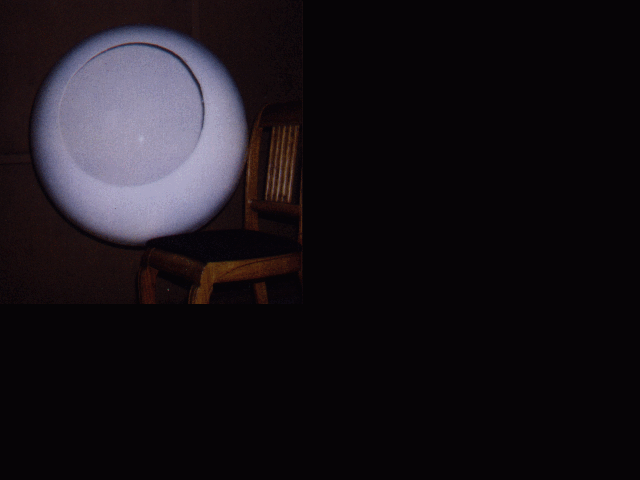
Optical Integrator Spheres
High-voltage
The Ultimate Powertrain

Smokey Days - wood and steel
Wood has been both fuel and shelter to human beings since ancient times. Even today, wood is a preferred enclosure material, despite being vulnerable to fire, decay, and insects. Wood has a homey feel and we do not wish to leave it. It may well be that well-worked wood will always be prized. Sometime during the human dawn, someone noticed that a really hot campfire melted metal or even glass out of the rocks, and thus we began to walk down the path towards civilization. The fires of our creativity worked wood, steel, silica, and other materials together to make tools, weapons, machines, structures. Thus, the Industrial Revolution, reaching its peak in the 20th century.
Most architecture of the 20th century has a certain rigidity about it, a heavy use of straight lines and right angles that comes from using beams of wood or steel. However, there were a few who had other ideas.
Ideas of the Giants - 20th century visionary architects
Buckminster Fuller - geodesic domes. One of the most economical and strongest enclosures ever developed. Standard structural engineering analysis techniques could not be used to predict the strength of a geo-dome.
Frank Lloyd Wright - a stable skyscraper, one mile high. The structure has a deep "tap root" like a strong tree, enabling the skyscraper to resist winds and earthquakes.
Paolo Soleri, a one-time student of Wright - Efficient, highly 3-dimensional cities designed to work in harmony with their economic and physical environment.
The Space Age - beyond steel
At the peak of the Industrial Revolution, we launched ourselves into space, driven by national pride. The Space Age brought a host of new materials for designers, engineers, and architects to work with, such as carbon fiber, Kevlar, Mylar, aerogel, glass fiber, and others. With these materials, it is possible to:
Hold a red-hot brick of glass foam in a bare hand.
Prevent limbs from being chopped off by machinery accident.
Weave jackets stronger than steel around bridge supports.
Let light in but keep heat or cold out
Form lightweight yet strong structures of any desired shape.
Yet, these materials have barely begun to be used in architecture. The proper use of these and other materials would result in cheaper and stronger enclosures with superior resistance to fire, flood, decay, and insects. For example, wood can be used as a framework for other materials to bond to, so that the wood is completely sealed off from the elements and thus relatively impervious. The same can be said for steel, if it is sealed off it has less chance of failure. However, in most places the building codes and the authorities are unable to time-and-cost effectively enable such construction. Thus, the main obstacle to bulding cheaper, better structures is, as always, City Hall and the money required to bribe(excuse me ;) expedite the process.
AUDIO
ONE-WAY DESIGNS:
One-way or fullrange designs rely on a single driver or transducer to deliver the full spectrum or full range of the audio bandwidth(spectrum). Implementations range from inexpensive fullrange "whizzer cone" speakers to the more pricey exotic "linear motor" ribbon speakers and electrostatics. Often plate-like transducers are used as well.
MULTI-WAY DESIGNS:
TWO-WAYS : Next logical step is to split up the delivery of the sound into low or low-to-mid and high or mid-to-high. This can be quite effective, both in terms of price and performance, if all of the relevant design factors are taken into account. Typically one or more bass or midbass woofers are matched with a suitable tweeter. Personally, I prefer that the tweeter be either an omni or some sort of non-circular shape transducer, since this improves the soundstage. All tweeters should be placed in small, egg or sphere shaped enclosures as close as possible(to prevent lobing) to the woofer. Tweeters (and midranges) should be aligned so that all sound is launched from the same physical axis, otherwise phase mis-alignment will occur and the crossover will have to be time-aligned to compensate. You shouldn't have to compensate if your design is done right to begin with. For example, most builders just stick the crossover somewhere in the same enclosure as the woofer. The problem with this is that the intense SPL's and vibration of the woofer can cause the capacitors to act as microphones causing distortion. So if your design has this flaw, you should compensate by acoustically shielding or padding the capacitors. If the crossover is in a subenclosure(such as a tweeter egg or sphere) it's not a problem. Again, good design eliminates problems before they become problems...
THREE-WAYS: Continuing the split-up, three transducers or even sets of transducers are used, to accomodate low, medium, and high frequencies (bass, mid, treble). Midranges benefit from being placed in either narrow and/or rounded (preferably both) enclosures. A narrow, rounded enclosure reduces diffraction and ceiling/floor reflections and improves imaging.
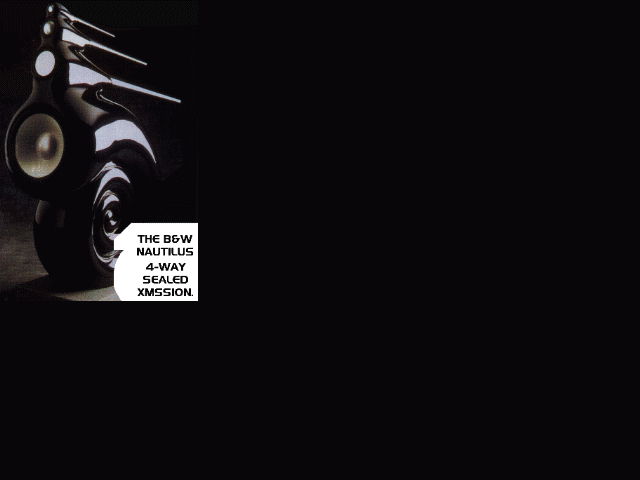 FOUR-WAYS: An outstanding example of solving a difficult problem using
a four-way approach is the Nautilus loudspeakers from B&W of England.
These insanely great speakers have a frequency response of 10Hz on up,
and look pretty wild as well having a crazy price of about $30,000 a pair.
FOUR-WAYS: An outstanding example of solving a difficult problem using
a four-way approach is the Nautilus loudspeakers from B&W of England.
These insanely great speakers have a frequency response of 10Hz on up,
and look pretty wild as well having a crazy price of about $30,000 a pair.TRANSDUCERS(DRIVERS)
There are zillions of different kinds of drivers on the market, in as many classes of cost. Ideally, drivers should be chosen to match the application, but often cost, convenience, appearance, or other things are the deciding factor.
...CIRCULAR-SHAPE TRANSDUCERS: These are often used successfully as bass and midbass, and are the typical "cone speaker", although there are "piston speaker" transducers where the "cone" is more like a flat plate. The cost/sound can also be very good(where cost is the concern) utilizing coaxial and "whizzer cone" (a.ka. dual cone) speakers. A formidable example of a coax is found in the KEF Uni-Q drivers, which combined with a spherical enclosure generate a perfect point sources, although limited in extended low frequency.
...LINEAR-SHAPE TRANSDUCERS: These usually are found as ribbon drivers, planar drivers, or cylindrical drivers.
BASS-IC CONFIGURATIONS:
...True bass response (from at least 20 Hertz on up) can be surprisingly difficult to achieve. Most loudspeaker designers simply give up and settle for something around 100 Hz. The die-hard extremists (excuse me, scientific purists) insist on a frequency response of "20Hz f3 anechoic" as a baseline for true bass, but for most rooms, an "f3" of 30 Hz is fine, because the room itself will boost the bass, especially if woofers are placed in corners, facing down the longest dimension of the room.
What "f3 anechoic" (also called -3db anechoic) means is that the lower the frequency, the more air the woofer has to pull and push in an anechoic environment(in other words, as if it were outdoors) the less sound it can make (unassisted by any "bass boost" electronics), this falloff or dropoff is measured in decibels, and f3 is the point at which the dropoff is three decibels below zero. Ordinarily, 12-inch woofers in substantial enclosures are the answer to the purist's thirst for power - I mean desire for extended bass. Although, large-capacity venues are the place where you need absolute bass fidelity. But, a loudspeaker designed for such coverage will sound over-bassy in most living rooms. Composite cones
PORTED CONFIGURATIONS:
Some purists object to the concept of a port at all, since it does put more stress on the driver, and the bass output drops off more sharply. However I've gotten good results with ported, and usually a quick computer check using a good Thiele/Small program will tell if the driver should be ported or not. Some drivers will sound good either ported or sealed, such as the Dynaudio 17W75XL, in fact this driver has even been used in car doors and it sounds pretty good. However, this particular driver is very forgiving.
SEALED CONFIGURATIONS:
Sealed cabinets deliver smooth rolloff and extended low frequency output, at the cost of lower efficiency and larger size.
SEALED TRANSMISSION LINE CONFIGURATIONS:
Again, the Nautilus loudspeakers utilize the sealed transmission line configuration. The length of the transmission line must be equal to a specific wavelength. Bass waves have very long wavelengths, hence the transmission line for the woofer of the Nautilus is coiled to save space.
OPEN TRANSMISSION LINE CONFIGURATIONS:
Open x-lines can be quite good. The open end of the x-line functions as a sort of passive radiator or port and is usually tuned to the driver's resonant frequency f(s). A spherical open x-line is under development by an affiliate of U.S. Enclosure.
EXOTIC WOOFERS:
Just a quick overview:
Servo woofer. Typically some sort of servo mechanism either activates a membrane or is actually mechanically coupled to the ground or a car frame. Have been used to communicate infrasonically with elephants. Cylindrical woofer. Exemplified by the Hsu subwoofers. Also found in much lesser quality in car subwoofers. The problem with cylindrical enclosures is that they represent pure acoustic mass, and thus must be engineered very carefully, otherwise will "boom" and have other resonance problems... Electrostatic woofer. We evaluated the e-stat sub/woofer technology and found it wanting. The f(s) is 35Hz. Sound cannon. Used by the military in the Gulf War, these devices are alleged to be suitcase-sized and were used to project the sound image of an approaching tank one or two miles forward into enemy foxholes.
Servo-driven composite vane. This technology is currently under investigation by U.S. Enclosure. Servo-driven dual-cone, dual-radiator - ContraBass The ContraBass can be squeezed down to a 4-cubic-foot cabinet with good results. The mechanical parts do require maintainence and performance is poor at low volumes. This technology is currently under investigation by U.S. Enclosure.
SPEAKER PLACEMENT RULES OF THUMB: FRONT SPEAKERS
==> Usually you want the speakers to project down the longest dimension in the room.
==> Sometimes you can't put the speakers so they project down the longest dimension, in fact one of the speakers may have to move a lot more air than the other because of the room. In this case, try adjusting the Left-Right balance to compensate
==> Sometimes you can't put the speakers so each one has the same distance to the nearest wall. Again, here you can try adjusting the Left-Right balance to compensate
==> Placing the speakers in the corners often boosts bass, depending on how reflective the nearby surfaces are. In some rooms you might not be able to utilize both corners in which case you could try moving them both closer to the listening area if possible and/or use some sort of bass boost.
==> If you have can put the speakers in the corners, and both speakers have the same distance to a nearby wall or cieling, now compare and contrast the sound by moving the speakers forward and inward a few feet into the room. ==> Pointing (most non-dipole) speakers inward increases precision at the expense of ambience.
==> Pointing (most non-dipole) speakers outward increases ambience at the expense of precision. SPEAKER PLACEMENT RULES OF THUMB: REAR SPEAKERS
Most rear-channel speakers give good results when hung high in the rear and pointed downward and slightly inward, separated by at least ten feet in most cases.
Good results can also be obtained by mounting small rear-channel speakers at the same height and pointing them inward and upward, however this should be experimented with first and is more dependent on what sounds are being played and the interior layout and architecture.
FUDGE, ,LIES, AND AUDIOHYPE
Let's begin with bass. Too many brands list useable frequency range on drivers and speakers. What this means all too often is that the number they give you is simply what it is just before the output crashes to zero. I mean, come on, I want to see some f3 here - I want to see the audible threshold drop - negative three dee Bee blast it! Well,ok, some companies are better than that they give you what it will sound like in a particular placement and room setting at a certain listening distance, so now you're up to f6 or f12 or f3 with or without room boost. Point is - always insist on plus or minus three deciBels. Or something besides an empty promise.
Oh, and, ditto for the high frequencies.
When designing the bass, two of my favorite fudges are Xmax and Power. Excursion and power are very important factors and should be given as peak and thermal RMS respectively, otherwise it can throw off your calculations so badly that, at best, it'll sound bad, and at worst ya smoke 'em.
Then of course there is the big lie which this web page is dedicated to fighting, which is that a box is the best shape for a loudspeaker.
These are my favorite (not!) pieces of fudge, lies, and audiohype. Let us know what your most hated lie is!
HIGH ENERGY
|
Click here for a review of integrals. |
 |
High-Voltage
A BRIEF REVIEW OF BASIC ELECTROSTATICS: Electrons are present in almost all matter. When these electrons flow through a conductor, this is called current flow. If these electrons even have the potential to flow, this is called a voltage field. Voltage is proportional to how much the matter resists the flow of current. Thus, high resistance can be used to develop a high voltage field - in other words, a force field.
SHAPE AFFECTS FUNCTION For example, a high-voltage, high-frequency generator is connected to a high-resistance resistor. The end of the resistor can then be connected to a sphere or spheroid.
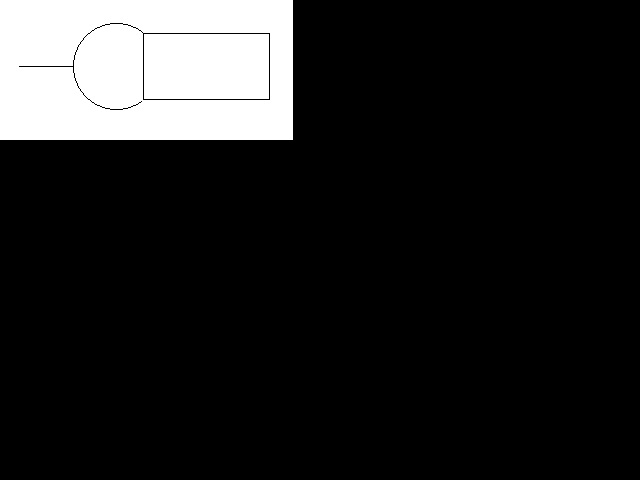 If a needle is then connected to the tip of the sphere, we now have an ion gun, and many interesting effects can be observed, such as levitation of small high-resistance particles via charge accumulation, in other words, making bread crumbs jump by shooting them full of ions. The beam can be used to etch biological tissue. And of course the field can be used to attract objects as well. The sphere acts as an electrostatic lens, (sort of like a chamber in a gun) the needle is the barrel of the gun. And if a tuft of steel wool is connected to the tip of the needle, it now becomes a spray bottle for electrons, and distributes them over a wide area, thus another class of effects comes into play.
The Ultimate Powertrain
A Gasoline-Fueled, Turbo-powered, Super-efficient, Near-Zero Emission, Very Low Maintenance Powertrain
The need to both reduce fossil fuel consumption and emissions remains a societal concern. However, performance, cost, and safety are what most vehicle buyers look for. This powertrain was developed by Rosen Motors (now bankrupt) in order to reconcile and achieve these goals. I don't know why the company went bankrupt but knowing how the (anti)competition(monopoly)(establishment) operates I can sure guess.. Here is how it works:
A carbon-fiber flywheel spins on a titanium hub at sixty thousand RPM on a magnetic bearing inside a vacuum chamber. The chamber is mounted in a gimbal-compensated, spherical-shaped carbon-fiber-and-steel composite containment enclosure, which is anchored to the vehicle with Kevlar-reinforced high-strength straps. All high-RPM applications must have high-strength enclosures for safety reasons. The flywheel is mated with a generator and is located at the rear of the vehicle, in this case a car. Pressing on the brake pedal to slow down stores energy to the flywheel. Pressing on the accelerator draws energy from the flywheel. At the front of the car is a turbogenerator (a turbine mated to a generator) which runs on ordinary unleaded gasoline and has near-zero pollutant emission levels. The turbogenerator keeps the flywheel/generator spinning at the proper speed, while the car is running. When the car is parked, two 12-volt batteries maintain the magnetic bearings. If the flywheel/generator does run down, the system starts the turbogenerator and spins up the flywheel/generator again. If the flywheel should fail, it could turn into an explosion of shrapnel. Fortunately, the spherical enclosure (the containment vessel) will prevent such an explosion. In fact, the containment vessel is mounted(along with the gimbals) inside a second spherical enclosure which contains a cooling liquid. Thus, if the flywheel fails, the gimbals will pull away and the containment vessel will slowly spin to a stop inside the cooling liquid. This whole arrangement prevents the flywheel from yanking on the vehicle during failure.
Reference: Scientific American, October 1997
| Main/Home | Loudspeakers | Technical | Test Page |